Research
Overview
My main research interests are network science and mathematical biology. In mathematical biology, I am mostly working on network-related topics: network science applied to biology and medicine. However, this is very often not mere applications of ready-to-use methods; the work often involves method development and validation. In network science, I am working on both non-bio things and bio-related things. I occasionally work on non-network research (evolutionary game theory unrelated to networks, science of science) but only a little. Below is a brief overview of each topic, with more recent ones coming first.
Early warning signals and sentinel nodes in network dynamics
Many complex systems — ecosystems, power grids, the brain, financial markets — can change abruptly, jumping from one state to a very different one once they are pushed past a so-called tipping point. Can we see such a jump coming before it happens? Often we can: as a system approaches a tipping point, its fluctuations tend to grow larger and to change more slowly over time, and these trends can serve as early warning signals. This has been studied since at least early 2000s. In fact, many systems for which we want to anticipating a tipping point are networks composed of many interacting parts: e.g., species in an ecosystem, regions of the brain, firms in a market. In network systems, we often cannot watch every part, and some part may give more informative early warning signals than others. So, which handful of nodes we monitor makes a big difference. We developed early warning signals tailored to network dynamics and ways to choose a small set of especially informative “sentinel” nodes that give the clearest advance warning. A closely related theme is dimension reduction: describing the collective behavior of a whole network with just a few variables, which helps explain why watching a few well-chosen nodes can work and keeps the mathematics manageable. The papers below build algorithms and theory behind these and related ideas and test them on both model and real-world networks.
- Naoki Masuda.
A theory of spatial early warning signals for tipping points on complex networks.
Preprint: arXiv:2608.15476
Code to generate the figure in the paper - Tharusha Bandara, Shilong Yu, Naoki Masuda.
Baseline-referenced spatial early warning signals for tipping points on heterogeneous networks.
Preprint: arXiv:2608.06608
Python codes - Naoki Masuda.
Detecting and forecasting tipping points from sample variance alone.
PNAS Nexus, 5, pgag126 (2026). [open access]
Preprint: arXiv:2602.10817
Python codes - Shilong Yu, Neil G. MacLaren, Naoki Masuda.
Using covariance of node states to design early warning signals for network dynamics.
Philosophical Transctions of the Royal Society A, 384, 20240486 (2026). [open access]
Preprint: arXiv:2505.15982
Python codes - Neil G. MacLaren, Baruch Barzel, Naoki Masuda.
Observing network dynamics through sentinel nodes.
Nature Communications, 16, 10211 (2025). [open access]
Preprint: arXiv:2408.00045
R codes - Neil G. MacLaren, Kazuyuki Aihara, Naoki Masuda.
Applicability of spatial early warning signals to complex network dynamics.
Journal of the Royal Society Interface, 22, 20240696 (2025). [open access]
Preprint: arXiv:2410.04303
R codes - Naoki Masuda, Kazuyuki Aihara, Neil G. MacLaren.
Anticipating regime shifts by mixing early warning signals from different nodes.
Nature Communications, 15, 1086 (2024). [open access]
R and Python codes
Phys.org news article
University at Buffalo Research News article - Neil G. MacLaren, Prosenjit Kundu, Naoki Masuda.
Early warnings for multistage transitions in dynamics on networks.
Journal of the Royal Society Interface, 20, 20220743 (2023). [open access]
R codes to produce the numerical results in the paper
Preprint: arXiv:2208.08961 - Naoki Masuda, Prosenjit Kundu.
Dimension reduction of dynamical systems on networks with leading and non-leading eigenvectors of adjacency matrices.
Physical Review Research, 4, 023257 (2022). [open access]
Typo
Preprint: arXiv:2203.13872
Python codes (numerical demonstration part is written in MATLAB) - Prosenjit Kundu, Hiroshi Kori, Naoki Masuda.
Accuracy of a one-dimensional reduction of dynamical systems on networks.
Physical Review E, 105, 024305 (2022). [open access]
Preprint: arXiv:2110.07140
Multilayer gene networks
I bring network science and data analysis to genetics, in collaboration with genome biologists. The tens of thousands of genes in our cells act in a coordinated way: genes that co-vary can be joined into a gene co-expression network. For example, looking at the “communities” of such a network — and how they change from one tissue to another — helps reveal which groups of genes work as a team. Using related ideas and methods, we also study, e.g., why some genes behave in a switch-like, all-or-nothing way that can raise or lower disease risk, how large duplicated stretches of DNA differ across animal species, and how structural differences in DNA vary among human populations. The common thread is using mathematics and computation to find meaningful patterns in multilayer genomic datasets.
- Alber Aqil, Saiful Islam, Faraz Hach, Ibrahim Numanagić, Naoki Masuda, Omer Gokcumen.
Genomes from 117 vertebrate species reveal rapidly evolving segmental duplication landscapes.
Genome Biology and Evolution, 18, evag043 (2026). [open access]
Preprint: https://doi.org/10.1101/2024.11.22.624925 - Alber Aqil, Yanyan Li, Zhiliang Wang, Saiful Islam, Madison Russel, Theodora Kunovac Kallak, Marie Saitou, Omer Gokcumen, Naoki Masuda.
Switch-like gene expression modulates disease risk.
Nature Communications, 16, 5323 (2025). [open access]
Preprint: https://doi.org/10.1101/2024.08.24.609537
Technology Networks news article
Press release - Madison Russell, Alber Aqil, Marie Saitou, Omer Gokcumen, Naoki Masuda.
Gene communities in co-expression networks across different tissues.
PLoS Computational Biology, 19, e1011616 (2023). [open access]
Preprint: arXiv:2305.12963
Python codes - Marie Saitou, Naoki Masuda, Omer Gokcumen.
Similarity-based analysis of allele frequency distribution among multiple populations identifies adaptive genomic structural variants.
Molecular Biology and Evolution, 39, msab313 (2022). [open access]
Preprint: https://doi.org/10.1101/2021.01.25.428140
Codes
Correlation networks
In many fields, we begin not with a network but with a big table of measurements — say, the activity of many brain regions over time, the price movements of many stocks, or the expression levels of many genes. A common way to turn such data into a network is to measure how strongly each pair of variables is correlated and to treat strong correlations as connections; the result is a correlation network. Building one well is in fact subtle: simply keeping the correlations above a chosen cutoff can create misleading structure. So, we develop more principled ways to construct correlation networks. In contrast to methods in statistics and machine learning, such as graphical lasso and covariance shrinkage, my main focus is to extract structures and numbers that network science proposed and have been useful (e.g., multilayer communities, clustering coefficient), but without transforming the original data into networks (because doing so introduces bias). I am also doing applications to genomics. The Physics Report paper below is a review of the whole area.
- Naoki Masuda, Zachary M. Boyd, Diego Garlaschelli, Peter J. Mucha.
Introduction to correlation networks: Interdisciplinary approaches beyond thresholding.
Physics Reports, 1136, 1-39 (2025). [open access]
Preprint: arXiv:2311.09536
Presentation video by Naoki Masuda (with Cassyni) - Madison Russell, Alber Aqil, Marie Saitou, Omer Gokcumen, Naoki Masuda.
Gene communities in co-expression networks across different tissues.
PLoS Computational Biology, 19, e1011616 (2023). [open access]
Preprint: arXiv:2305.12963
Python codes - Sadamori Kojaku, Naoki Masuda.
Constructing networks by filtering correlation matrices: A null model approach.
Proceedings of the Royal Society A: Mathematical, Physical and Engineering Sciences, 475, 20190578 (2019).
Request the paper
Preprint: arXiv:1903.10805
Python codes - Naoki Masuda, Sadamori Kojaku, Yukie Sano.
Configuration model for correlation matrices preserving the node strength.
Physical Review E, 98, 012312 (2018). [open access]
Typo
Preprint: arXiv:1806.08709
MATLAB codes - Naoki Masuda, Michiko Sakaki, Takahiro Ezaki, Takamitsu Watanabe.
Clustering coefficients for correlation networks.
Frontiers in Neuroinformatics, 12, 7 (2018). [open access]
Typo
Preprint: arXiv:1806.10228
Download presentation slides
Python and C++ codes
Temporal network data analytics
Many networks are not fixed: the links between people, animals, neurons, or devices switch on and off over time, and the exact timing of contacts can matter as much as who is connected to whom. Networks that keep this timing information are called temporal networks. As data with precise time stamps become widely available, we need good ways to represent, summarize, and compare them. We develop such tools — for example, methods that turn an evolving network into a trajectory or a low-dimensional embedding so that its changes can be visualized and analyzed, and techniques for detecting recurring states or activity patterns in a network that changes over time.
- Lucas Lacasa, F. Javier Marín-Rodríguez, Naoki Masuda, Lluís Arola-Fernández.
Scalar embedding of temporal network trajectories.
Chaos, Solitons and Fractals, 199, 116599 (2025). [open access]
Preprint: arXiv:2412.02715 - Chanon Thongprayoon, Naoki Masuda.
Spline tie-decay temporal networks.
Journal of Computational Science, 88, 102591 (2025). [open access]
Preprint: arXiv:2408.11913
Python codes (only to generate kernel functions) - Chanon Thongprayoon, Lorenzo Livi, Naoki Masuda.
Embedding and trajectories of temporal networks.
IEEE Access, 11, 41426-41443 (2023). [open access]
Preprint: arXiv:2208.02869
Python codes - Marinho A. Lopes, Jiaxiang Zhang, Dominik Krzemiński, Khalid Hamandi, Qi Chen, Lorenzo Livi, Naoki Masuda.
Recurrence quantification analysis of dynamic brain networks.
European Journal of Neuroscience, 53, 1040-1059 (2021). [open access]
Preprint: arXiv:2001.03761 - Naoki Masuda, Renaud Lambiotte.
A Guide to Temporal Networks.
World Scientific, Singapore (2020).
(The first edition was published in 2016.) - Naoki Masuda, Petter Holme.
Detecting sequences of system states in temporal networks.
Scientific Reports, 9, 795 (2019). [open access]
Preprint: arXiv:1803.04755
Python and MATLAB codes
Short introduction to this research
日本語の研究紹介 (in Japanese)
Temporal network theory
A question complementary to temporal network data analytics is what temporal structure actually does: how the timing of connections changes processes that unfold on a network, such as the spread of an epidemic or a rumor, the evolution of cooperation, or the formation of opinions. Real-world contacts tend to be bursty and correlated rather than smooth and random, and this can speed up, slow down, or even qualitatively change such dynamics compared with a static network. We build and analyze mathematical and computational models — for instance, of how concurrent (overlapping) partnerships affect contagion, how evolutionary games play out when the network keeps switching, and how to simulate bursty, non-Markovian dynamics efficiently — and use them to understand, and sometimes control, what happens on temporal networks.
- Aming Li, Yao Meng, Lei Zhou, Naoki Masuda, Long Wang.
Temporality modulates the effect of network heterogeneity on cooperation fixation.
Nature Communications, 17, 6238 (2026). [open access]
Preprint: arXiv:2309.12686 - Harrison Hartle, Naoki Masuda.
Autocorrelation properties of temporal networks governed by dynamic node variables.
Physical Review Research, 7, 013083 (2025). [open access]
Preprint: arXiv:2408.16270 - Maisha Islam Sejunti, Dane Taylor, Naoki Masuda.
A Parrondo paradox in susceptible-infectious-susceptible dynamics over periodic temporal networks.
Mathematical Biosciences, 378, 109336 (2024). [open access]
Preprint: arXiv:2406.16787 - Hang-Hyun Jo, Tibebe Birhanu, Naoki Masuda.
Temporal scaling theory for bursty time series with clusters of arbitrarily many events.
Chaos, 34, 083110 (2024). [open access]
Preprint: arXiv:2403.17093 - Ruodan Liu, Masaki Ogura, Elohim Fonseca dos Reis, Naoki Masuda.
Effects of concurrency on epidemic spreading in Markovian temporal networks.
European Journal of Applied Mathematics, 35, 430-461 (2024). [open access]
Preprint: arXiv:2201.00754 - Jnanajyoti Bhaumik, Naoki Masuda.
Fixation probability in evolutionary dynamics on switching temporal networks.
Journal of Mathematical Biology, 87, 64 (2023). [open access]
Preprint: arXiv:2304.00170
Python codes - Kashin Sugishita, Mason A. Porter, Mariano Beguerisse-Díaz, Naoki Masuda.
Opinion dynamics on tie-decay networks.
Physical Review Research, 3, 023249 (2021). [open access]
Preprint: arXiv:2010.00143 - Naoki Masuda, Joel C. Miller, Petter Holme.
Concurrency measures in the era of temporal network epidemiology: A review.
Journal of the Royal Society Interface, 18, 20210019 (2021). [open access]
Preprint: arXiv:2012.13317 - Naoki Masuda, Renaud Lambiotte.
A Guide to Temporal Networks.
World Scientific, Singapore (2020).
(The first edition was published in 2016.) - Elohim Fonseca dos Reis, Aming Li, Naoki Masuda.
Generative models of simultaneously heavy-tailed distributions of inter-event times on nodes and edges.
Physical Review E, 102, 052303 (2020). [open access]
Preprint: arXiv:2008.13034 - Masaki Ogura, Victor M. Preciado, Naoki Masuda.
Optimal containment of epidemics over temporal activity-driven networks.
SIAM Journal on Applied Mathematics, 79, 986-1006 (2019).
Request the paper
Preprint: arXiv:1802.08961 - Naoki Masuda, Luis E. C. Rocha.
A Gillespie algorithm for non-Markovian stochastic processes.
SIAM Review, 60, 95-115 (2018). [open access]
Preprint: arXiv:1601.01490
C/C++ codes for the Laplace Gillespie algorithm, one to generate positively correlated inter-event times etc.
Short introduction to this research
日本語の研究紹介 (in Japanese) - Tomokatsu Onaga, James P. Gleeson, Naoki Masuda.
Concurrency-induced transitions in epidemic dynamics on temporal networks.
Physical Review Letters, 119, 108301 (2017). [open access]
Preprint: arXiv:1702.05054
Download presentation slides - Naoki Masuda, Konstantin Klemm, Víctor M. Eguíluz.
Temporal networks: slowing down diffusion by long lasting interactions.
Physical Review Letters, 111, 188701 (2013). [open access]
Preprint: arXiv:1305.2938
Energy landscape analysis
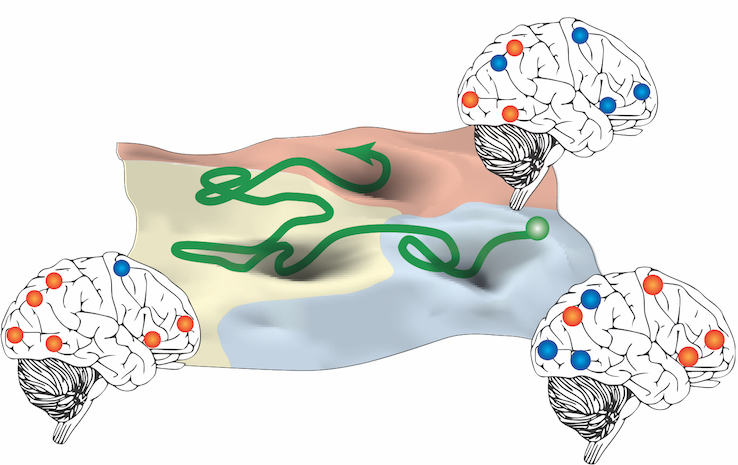
Energy landscape analysis is a method we have been developing to make sense of multichannel dynamical data — many time series recorded together, such as brain signals from multiple regions of interest (but the data need not be biological). The idea is to picture the system as a ball rolling on a landscape of hills and valleys: each valley is a relatively stable pattern of activity that the system tends to settle into, and the hills are barriers it must cross to reach another. From the data alone we estimate this landscape and read off how many stable states there are, how they connect, and how the system moves among them — turning a high-dimensional recording into an intuitive map of a few states, which we apply mainly to neuroimaging. Differences in the energy landscape between patients and healthy people can be useful biomarkers, which various research (mostly done by other people using this method) is supporting. Below, PLoS Complex Systems (2025) and Phil. Trans. R. Soc. A (2017) papers are review papers.
- Daiki Tatematsu, Naotoshi Nakamura, Masato S. Abe, Tetsuo Ishikawa, Takahiro Ezaki, Lin Cai, Eiryo Kawakami, Kazuyuki Aihara, Atsushi Nishida, Naohiro Okada, Naoki Masuda, Kiyoto Kasai, Shinsuke Koike, Shingo Iwami.
Psychological distress among Japanese high school students during the COVID-19 pandemic: An energy landscape analysis.
PLoS Medicine, 23, e1004884 (2026). [open access] - Naoki Masuda, Saiful Islam, Si Thu Aung, Takamitsu Watanabe.
Energy landscape analysis based on the Ising model: Tutorial review.
PLoS Complex Systems, 2, e0000039 (2025). [open access]
Preprint: arXiv:2411.16979 - Pitambar Khanra, Johan Nakuci, Sarah Muldoon, Takamitsu Watanabe, Naoki Masuda.
Reliability of energy landscape analysis of resting-state functional MRI data.
European Journal of Neuroscience, 60, 4265-4290 (2024). [open access]
Preprint: arXiv:2305.19573
Codes - Takahiro Ezaki, Elohim Fonseca dos Reis, Takamitsu Watanabe, Michiko Sakaki, Naoki Masuda.
Closer to critical resting-state neural dynamics in individuals with higher fluid intelligence.
Communications Biology, 3, 52 (2020). [open access]
C code (the code to gather outputs stored in different files is in Python) - Takahiro Ezaki, Michiko Sakaki, Takamitsu Watanabe, Naoki Masuda.
Age-related changes in the ease of dynamical transitions in human brain activity.
Human Brain Mapping, 39, 2673-2688 (2018). [open access] - Takahiro Ezaki, Takamitsu Watanabe, Masayuki Ohzeki, Naoki Masuda.
Energy landscape analysis of neuroimaging data.
Philosophical Transactions of the Royal Society A, 375, 20160287 (2017). [open access]
MATLAB code for calculating and visualizing energy landscapes is availble here.
MATLAB code to calculate the maximum-likelihood estimator is also available as the supplementary material of the paper. - Takamitsu Watanabe, Naoki Masuda, Fukuda Megumi, Ryota Kanai, Geraint Rees.
Energy landscape and dynamics of brain activity during human bistable perception.
Nature Communications, 5, 4765 (2014). [open access]
MATLAB code for calculating and visualizing energy landscapes is availble here.
MATLAB code to calculate the maximum-likelihood estimator is also available as the supplementary material of one of our papers.
日本語の研究紹介 (in Japanese) - Takamitsu Watanabe, Satoshi Hirose, Hiroyuki Wada, Yoshio Imai, Toru Machida, Ichiro Shirouzu, Seiki Konishi, Yasushi Miyashita, Naoki Masuda.
A pairwise maximum entropy model accurately describes resting-state human brain networks.
Nature Communications, 4, 1370 (2013). [open access]
Unofficial errata
MATLAB code to calculate the maximum-likelihood estimator is also available as the supplementary material of one of our papers.
Networks in public health
Network thinking is useful across many public-health problems. In this line of work, I mostly apply network methods, often in collaboration with public-health specialists. Examples include mapping the “journeys” that people take during opioid overdose behavior, studying online social networks of people affected by adverse childhood experiences or expressing suicidal thoughts, and using medical record data from a hospital to help limit infections that spread within a hospital contact network.
- Lucas H. McCabe, Naoki Masuda, Shannon Casillas, Nathan Danneman, Alen Alic, Royal Law.
Network analysis of U.S. non-fatal opioid-involved overdose journeys, 2018-2023.
Applied Network Science, 9, 68 (2024). [open access]
Preprint: arXiv:2402.03294 - Yiding Cao, Suraj Rajendran, Prathic Sundararajan, Royal K. Law, Sarah Bacon, Steven A. Sumner, Naoki Masuda.
Web-based social networks of individuals with adverse childhood experiences: Quantitative study.
Journal of Medical Internet Research, 25, e45171 (2023). [open access]
Preprint:https://doi.org/10.1101/2022.12.19.22283651
Codes - Naoki Masuda, Issei Kurahashi, Hiroko Onari.
Suicide ideation of individuals in online social networks.
PLoS ONE, 8, e62262 (2013). [open access]
Correction: Suicide ideation of individuals in online social networks.
PLoS ONE, 9, 10.1371/annotation/d589857d-b3c6-4a16-acfe-423f9bf529f1 (2014).Preprint: arXiv:1207.0561
Featured by MIT Technology Review
Featured by I Programmer news
日本語の研究紹介 (in Japanese)
- Taro Ueno, Naoki Masuda.
Controlling nosocomial infection based on structure of hospital social networks.
Journal of Theoretical Biology, 254, 655-666 (2008). [open access]
Preprint: arXiv:0803.1879
Download presentation slides
Evolutionary dynamics on networks
How does the structure of a population shape which behaviors or traits spread and eventually take over? In evolutionary dynamics on networks, individuals sit on the nodes of a network and interact with their neighbors, and we ask questions such as how likely a new mutant or strategy is to spread to the whole population (its fixation probability) and how fast this happens. A central case is evolutionary games on networks, in which individuals play social-dilemma games such as the prisoner’s dilemma game with their neighbors; here the network structure can strongly affect whether cooperation survives. We study these questions on ordinary networks and on richer structures — weighted, multilayer, temporal, and higher-order (hypergraph) networks — and consider effects such as committed “zealots” and feedback between individuals and their environment, for example.
- Jnanajyoti Bhaumik, Naoki Masuda.
Non-dilemmatic social dynamics promote cooperation in multilayer networks.
Preprint: arXiv:2601.00460
Python codes - Aming Li, Yao Meng, Lei Zhou, Naoki Masuda, Long Wang.
Temporality modulates the effect of network heterogeneity on cooperation fixation.
Nature Communications, 17, 6238 (2026). [open access]
Preprint: arXiv:2309.12686 - Jnanajyoti Bhaumik, Naoki Masuda.
Constant-selection evolutionary dynamics on weighted networks.
Proceedings of the Royal Society A: Mathematical, Physical and Engineering Sciences, 480, 20240223 (2024). [open access]
Preprint: arXiv:2403.17208
Python codes - Katherine Betz, Feng Fu, Naoki Masuda.
Evolutionary game dynamics with environmental feedback in a network with two communities.
Bulletin of Mathematical Biology, 86, 84 (2024). [open access]
Preprint: arXiv:2404.17082 - Ruodan Liu, Naoki Masuda.
Fixation dynamics on multilayer networks.
SIAM Journal on Applied Mathematics, 84, 2028-2050 (2024). [open access]
Preprint: arXiv:2311.16457 - Ruodan Liu, Naoki Masuda.
Fixation dynamics on hypergraphs.
PLoS Computational Biology, 19, e1011494 (2023). [open access]
Preprint: arXiv:2301.05343
Python codes to produce the numerical results in the paper - Jnanajyoti Bhaumik, Naoki Masuda.
Fixation probability in evolutionary dynamics on switching temporal networks.
Journal of Mathematical Biology, 87, 64 (2023). [open access]
Preprint: arXiv:2304.00170
Python codes - Alessio Cardillo, Naoki Masuda.
Critical mass effect in evolutionary games triggered by zealots.
Physical Review Research, 2, 023305 (2020). [open access]
Preprint: arXiv:1912.00400 - Akio Iwagami, Naoki Masuda.
Upstream reciprocity in heterogeneous networks.
Journal of Theoretical Biology, 265, 297-305 (2010). [open access]
Preprint: arXiv:0905.4007
Preprint: METR (Mathematical Engineering Technical Reports) 2010-25, University of Tokyo - Naoki Masuda, Hisashi Ohtsuki.
Evolutionary dynamics and fixation probabilities in directed networks.
New Journal of Physics, 11, 033012 (2009). [open access]
Preprint: arXiv:0812.1075 - Naoki Masuda.
Participation costs dismiss the advantage of heterogeneous networks in evolution of cooperation.
Proceedings of the Royal Society B: Biological Sciences, 274, 1815-1821 (2007).
Request the paper
Preprint: arXiv:physics/0702017
Download presentation slides
Modeling and data analysis of animal behavior
Animals in a group interact with one another to accomplish collective tasks — ants selecting and moving to a new nest, sharing information during an emigration, or forming dominance hierarchies, and homing pigeons settling on a route as a flock. I study such collective animal behavior by combining mathematical modeling with data analysis, usually together with biologists: building models of how group-level decisions emerge from simple rules that individuals follow, and sometimes using network analysis to describe who interacts with whom and how information and influence flow through a group.
- Takao Sasaki, Naoki Masuda, Richard P. Mann, Dora Biro.
Empirical test of the many-wrongs hypothesis reveals weighted averaging of individual routes in pigeon flocks.
iScience, 25, 105076 (2022). [open access] - Gabriele Valentini, Naoki Masuda, Zachary Shaffer, Jake R. Hanson, Takao Sasaki, Sara Imari Walker, Theodore P. Pavlic, Stephen C. Pratt.
Division of labor promotes the spread of information in colony emigrations by the ant Temnothorax rugatulus.
Proceedings of the Royal Society B: Biological Sciences, 287, 20192950 (2020).
Preprint: https://doi.org/10.1101/791996
Featured by ASU Now
Video - Thomas A. O'Shea-Wheller, Naoki Masuda, Ana Sendova-Franks, Nigel R. Franks.
Variability in individual assessment behaviour and its implications for collective decision-making.
Proceedings of the Royal Society B: Biological Sciences, 284, 20162237 (2017).
Featured by New Scientist - Naoki Masuda, Thomas A. O'Shea-Wheller, Carolina Doran, Nigel R. Franks.
Computational model of collective nest selection by ants with heterogeneous acceptance thresholds.
Royal Society Open Science, 2, 140533 (2015). [open access] - Hiroyuki Shimoji, Masato S. Abe, Kazuki Tsuji, Naoki Masuda.
Global network structure of dominance hierarchy of ant workers.
Journal of the Royal Society Interface, 11, 20140599 (2014). [open access]
Download presentation slides
Dominance network data are available at the journal's website.
日本語の研究紹介 (in Japanese)